

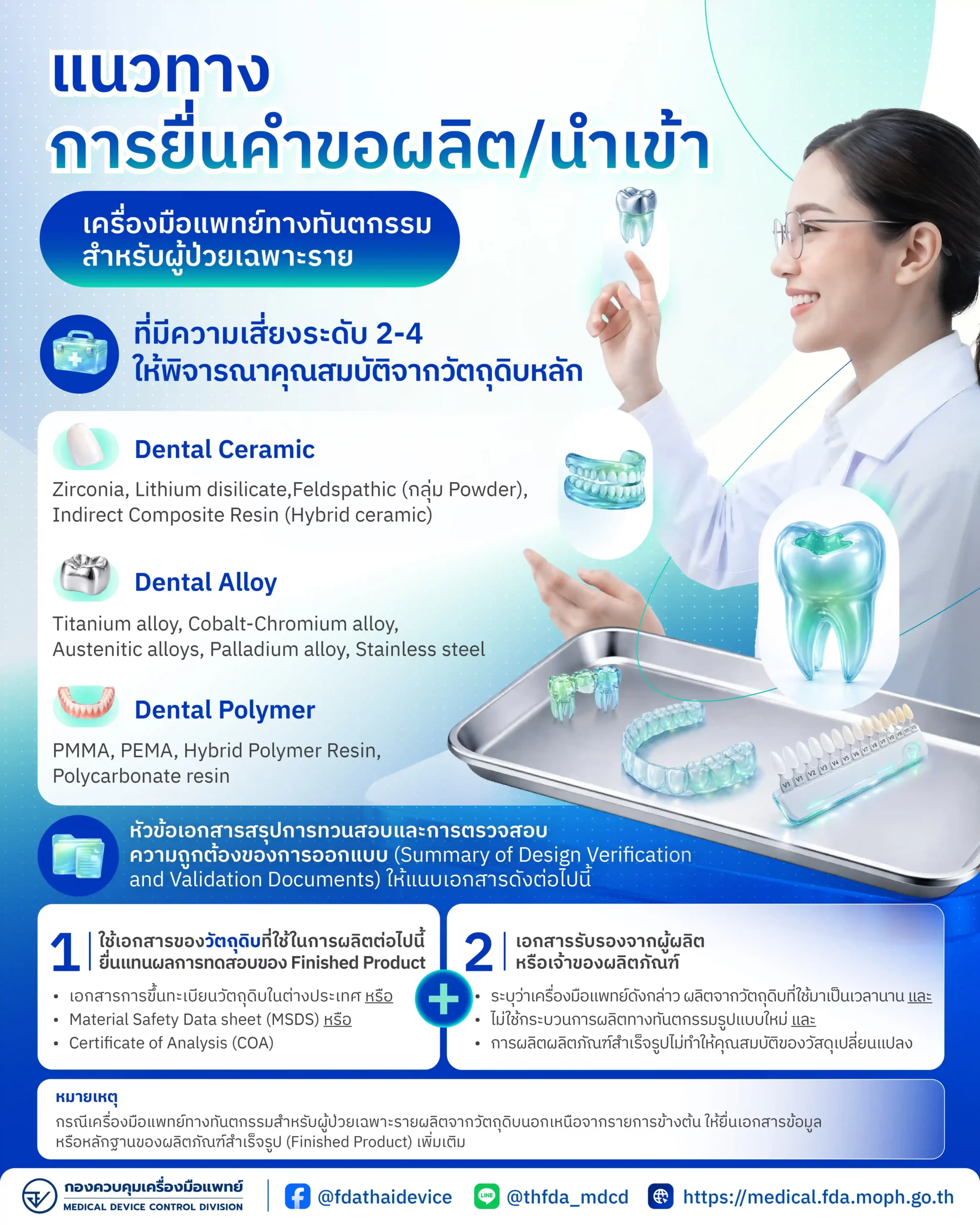
The Thai FDA has issued guidelines for the registration of patient-specific dental medical devices under Risk Classification 2–4.
The key consideration is that product properties are assessed based on the primary raw materials rather than the finished product.
Read the full infographic here: กองควบคุมเครื่องมือแพทย์ (Thai FDA Official Website in Thai).
Purpose of the Guideline
To provide guidance on the manufacturing/import license application for patient-specific dental medical devices under Risk Classification 2–4.
To clarify that product properties should be assessed based on the primary raw materials used, rather than the finished product.
Scope of Application
This guideline applies to manufacturers and importers registering patient-specific dental medical devices under Risk Classification 2–4 in Thailand.
Raw Materials Under Consideration
Dental Ceramic
- Zirconia
- Lithium disilicate
- Feldspathic (Powder group)
- Indirect Composite Resin (Hybrid ceramic)
Dental Alloy
- Titanium alloy
- Cobalt-Chromium alloy
- Austenitic alloys
- Palladium alloy
- Stainless steel
Dental Polymer
- PMMA
- PEMA
- Hybrid Polymer Resin
- Polycarbonate resin
Documentation Requirements
Summary of Design Verification and Validation Documents
Documents must be submitted in the following format:
Material Documents
Material documents may be submitted instead of finished product test results, including:
- Foreign material registration documents; or
- Material Safety Data Sheet (MSDS); or
- Certificate of Analysis (COA)
Certified Document from the Physical Manufacturer or Product Owner
A certified document should state that:
- The medical device has been previously manufactured using the same raw materials for a period of time;
- It does not use a new dental manufacturing process; and
- The finished product manufacturing does not change the properties of the material.
Note
For patient-specific dental medical devices manufactured from raw materials not listed above, additional information or evidence of the finished product must be submitted.
Implications to Clients
Manufacturers and importers should carefully consider this guideline when registering patient-specific dental medical devices with Risk Classification 2–4.
Since product properties are assessed based on the raw materials, namely Dental Ceramics, Alloys, or Polymers, registration documentation, particularly product verification and validation, must comply with these requirements.
Effective Date
Currently effective
For Inquiries
For inquiries or support regarding medical device regulatory requirements in Thailand, please contact sales@andamanmed.com.